Political Apathy
An Obstacle for America's Democracy

I keep seeing posts online that glorify being apolitical and encourage people to disregard politics. They claim engaging with politics just adds more things for you to worry about. While I understand that arguing about politics in the comments section is not the best use of anybody’s time, these posts infuriate me because I believe that this attitude is incredibly damaging for democracies. This also comes at an opportune time as we have never seen western democracies as weak as they are today.
Understanding Where This Attitude Comes From
I want to start by empathizing with those that disregard politics. Most of what happens in politics is outside of one’s control. The stoic mantra of focusing on things within your control seems wise. It is easier (and probably healthier) to focus on your family, your relationships, your job, and your hobbies than it is to keep up with whatever new tariff decision Trump decides to make today. However, this ability to just go on about your life while not involving yourself in politics is a privilege that is not extended to all. If you have a good job that provides you with healthcare, are wealthy enough to own your home, and provide your family a good standard of living; then the incentive to enact change and therefore keep up with politics is very low. The current system and the conditions it has created is working for you. On the other hand, if you are a minimum wage worker with no health care coverage, no way of building your wealth or ever owning property, and whose unionization efforts to obtain better working conditions keep getting shut down by the multinational corporation you work for, then the current system is clearly not working for you. Your incentive to enact political change is higher.
I would like to argue that as inequality grows and living standards fall in western societies, more and more people will find themselves in the latter situation. This trend has already begun, the price of assets keeps growing while wages stagnate. Building your wealth is more difficult than it was decades ago. Real estate is no longer as accessible as it used to be. A commoditized university education means more and more educated young workers are now competing for the same jobs (without even considering the disruption created by AI). This allows corporations to keep wages low since the supply of workers has increased. As economic outlook worsens, living standards fall, and people become disillusioned with the current system, societal decay ensues.
Leading to Societal Decay
The majority of the population is seeing their conditions worsen while the price of assets keep rising. Housing gets more and more expensive every year and the stock market keeps breaking record highs while wages have not experienced the same level of growth. The chasm between the average member society and its richest keeps getting wider. According to the American Federal Reserve, in 2024, the top 10% of households held about 67% total household wealth1. For comparison, wealth inequality in France right before its bloody and violent revolution in 1789 was estimated by Piketty such that the top 10% held about 90% of the wealth. I am not suggesting the United States of America are headed towards a revolution but if things keep going the way they are, things will keep getting worse before they get better. That household wealth inequality metric will keep increasing closer pre-revolution France. In America, where social services are underdeveloped (healthcare, education, public transportation…), it is even more important for the average citizen to have some level of wealth to be able to afford what has been deemed as human rights in other developed countries. While the average Americans struggle to afford the bare necessities, the affluent post selfies on their yacht or private planes — this brutal juxtaposition sows seeds of discord.
These seeds will eventually grow and it makes you wonder for how long this can keep going before something gives. We are already seeing this frustration manifest itself into horrific acts, such as the murder of the UnitedHealthcare CEO. The online reactions were divisive, between those calling Luigi Mangione a criminal and others seeing him as a rebel/hero. He has become a symbol for those that feel disenfranchised by USA’s healthcare system. If people keep becoming increasingly dissatisfied, these kinds of acts will increase in frequency and intensity. It will erode the fabric of society, people will be less trusting of others and will start to fear for their safety within their own country (this is already the case in the more downtrodden parts of America but imagine if this became the norm).
As frustration grows, protests and riots are bound to happen. We are seeing this happen in California. How the federal government responded is quite telling of the state of America’s democracy. Trump ordered the national guard to be deployed, disregarding the state of California’s rights and ignoring its governor’s requests. This is quite ironic coming from the candidate who promised less federal government intervention. The most worrying part of this is how journalists reporting on this issue are treated. Between being unlawfully detained2 or being shot at3, freedom of press is under attack. Authoritarian regimes control the media by threatening journalists with the goal of controlling the information their populations have access to — not democracies.
Another indicator of a crippling democracy is to look at the decreasing quality and integrity of politicians. The American presidential election of 2012 featured Barack Obama and Mitt Romney. When debating, these two politicians were eloquent, intelligent, and respectful of each other. You get the sense that there is something greater at stake (the future of a country) during their debate than personal image or ego. Whereas the 2024 presidential election, featuring mind-demented Joe Biden and middle school bully Donald Trump, seemed more like reality TV than a political debate. Even when Biden was replaced by Kamala, the quality of debates was still nowhere near 2012. Kamala displayed little charisma or eloquence during any of her speeches. I doubt she would have been the democratic party representative had they had a proper democratic party primary to elect the democratic party presidential nominee.
As living conditions worsen, divisions grow, and politicians make fools of themselves, you would expect the population to exert more pressure on the government to act and address these issues. But this is a tale as old as time; When have the rich and powerful listened to the pleas of the poor and powerless?
Power Corrupts
It is a given that within any hierarchical power structure, there is always some degree of corruption. But the American elite recently reminded us that American exceptionalism is applicable across all disciplines. Elon Musk essentially bought himself access to the US government and president with a small donation of $288 million4 . Is there anything money cannot do in the USA? He then created his own government agency DOGE (Department of Government Efficiency) which is responsible for cutting budgets of or even completely removing other government departments. Some of these other government departments are responsible for tax incentives/cuts and industry regulations. There would seem to be a clear conflict of interest if the CEO of Tesla (EV tax cuts, automobile industry regulations) and SpaceX (government contracts and aerospace industry regulations) were to become in charge of the budgets of government departments handling the regulations and tax laws of said industries.
The corruption that occurs when businesses and corporations sway government officials is called bribery except in the western world where it is defined as lobbying. This type of corruption is one of the greatest betrayals a politician could do to their own people. The politician makes a value judgement that their personal financial interests and the interests of the company lobbying are more important than the interests of the American people who elected them and trusted them with the responsibility of representing them in these negotiations. During a lobbying negotiation, the lobbyist present arguments to the politician about how certain legislative measures might help their industry or company. It is the politician’s job to always consider how this will affect the general population.
Grace Blakeley goes into great detail about the insidious nature of lobbying and many other corporate wrongdoings in her book ‘Vulture Capitalism’ which I highly recommend. One of the many examples in her book of lobbying actively harming the general population is tax software like TurboTax. “The two largest sellers of this tax software — Intuit and H&R Block — spent a combined $5 million trying to defeat bills that would either introduce a simpler, centralised system for the calculation of individual taxes, or which would have allowed the IRS to provide free software that individuals could use to file their own tax returns. They were largely successful in this effort, and to this day most Americans pay for tax-filling software, while the major tax firms attempt to keep secret the ways that it is possible to file taxes for free.”5. These companies have fabricated complexity and scarcity by hiding free alternatives. They continually dupe the American people into purchasing their product. Every single year, Americans use a costlier and more inefficient solution to file their taxes because a small group of people composed of the lobbyists and politicians decided that their interests outweigh those of the entire population. These firms no longer create value for their customers but as Blakeley’s title suggests, act like vultures, scavenging their profits off their customers.
If paying a bit of money once a year to file your taxes does not seem like that big of deal to you, perhaps lobbying in the health and food industry might change your mind. Max Lugavere was invited on Fox News to reveal the collusion happening between the FDA, USDA, The Academy of Nutrition and Dietetics, and corporate giants in the food, health, and pharmaceuticals industries6. He mentions the ‘Revolving Door’ concept in which 11 out of 12 FDA commissioners who are supposed to regulate the pharmaceutical industry go on to take high-paying jobs at the very pharmaceutical companies they were supposed to regulate. He also mentions that almost 50% of the FDA’s budget is funded by the pharmaceutical industry. The conflict of interest and corruption could not be more flagrant. Pharmaceutical companies fund the government agency that is supposed to regulate their industry and if the regulators do a good job of not interfering with the pharmaceutical companies’ profits, they are rewarded with a cushy job to get their share of the profits. All the while, the Center for Disease Control and Prevention reports that 74% of American adults are overweight or obese7. Almost 3/4 of the US population are going to lead less fulfilling and limited lives due to their poor health. More and more research is coming out every year linking obesity to diseases like diabetes and Alzheimer’s. The majority of Americans will be plagued by illnesses and robbed of their lifespan because politicians sold their constituents’ health in exchange for personal gain in the forms of gifts and money. There are many quotes showcasing how invaluable health is such as ‘Health is Priceless’. American politicians seem to disagree and show us that the American people’s health clearly has a price since it can be bought.
Lobbying encourages corruption by permitting collusion between the wealthy and politicians at the expense of the general population. But don’t be fooled, politicians do not need to be enticed by large sums of money or lavish gifts from lobbyist for their moral compass to falter. They will be dishonest for their own selfish interests.
The 2024 Presidential election showcased new all times lows in integrity for both parties. Harris was caught running two versions of the same advertisement about Palestine/Israel in different states8. Her campaign ran the pro-Israel version of the ad in states that had a large Jewish demographic and the pro-Palestine one in the state of Michigan which contains a large Arab population. I’m not sure which is worse; the act of blatantly lying to your voters or thinking none of their voters would find out. Two-faced Harris lost all credibility and the state of Michigan over this foolish ploy.
The republican party candidate is no better, president Trump has no shortage of examples. Let us take his most recent statements about tariffs. Trump justified his tariffs by saying that trade deficits indicate that America is getting a bad deal and being treated unfairly by its trading partners. America having a trade deficit with another country simply means that America imports more from that country than it exports to it. Take Canada for example, if Canada stopped exporting oil to the US, the US would no longer have a trade deficit with Canada. Yet the US benefits from importing low transportation cost Canadian oil and using it to fuel its industry. Let’s now look at China or any other Asian country that has a trade deficit with the US. Most of these countries offer low-cost labor for manufacturing, US corporations offshore manufacturing to those countries because it is more profitable for them to do so. It also benefits the American people, if those companies are able to reduce their costs, the final price of their product will be lower and more affordable for the American consumer. What if Apple manufactured the iPhone in America? According to Dan Ives, prices could triple rendering them unaffordable for most Americans9. American trade deficits also signal that American consumers have higher purchasing power and are able to buy more goods with their American dollars than consumers in other countries. If anything, a trade deficit seems to indicate that America is getting the better end of its trade deals.
Trump also stated that tariffs would not raise prices. Most economists predicted that tariffs would increase costs for corporations that depend on imports for their business model. Those corporations would usually pass on these cost increases to their customers because they do not want to absorb the cost increases and see their their profit margins go down. This phenomenon was observed during the 2018-2019 tariffs during Trump’s first term leading to price increases10. Both of Trump’s statements on tariffs were factually incorrect. Trump’s only saving grace is that one is never sure if he is purposefully dishonest or if he simply does not understand what he is talking about.
Political corruption does not stop at politicians lying to their voters to vie for public support but also involves them bolstering their personal financial position. Nancy Pelosi is the poster child of government insider trading. Even though, as a US Congress member, she only makes an annual salary of $174,00011, her net worth is estimated to be around $246 million12, in part due to her husband but also due to her phenomenal trading acumen. She is such an excellent trader, she has an index fund named after her that matches her trading activity13. The returns of this index since 05/16/2014 are +729.14% compared to the S&P 500 ETF’s returns of +213.42%. Perhaps Nancy Pelosi should think of doing a career change. She seems to be one of the best traders in the world, even beating every hedge fund in 2024, who spend vast amounts of money hiring the brightest quantitative analysts and data scientists14. It is obvious that politicians responsible for potential legislation that could stimulate certain sectors of the economy and who constantly receive business information from lobbyists have access to insider information not available to the public. While this is not currently illegal, it is clearly unethical and a conflict of interest. The PELOSI bill15, named after our infamous Nancy, might change that and force politicians to focus on their job instead of stock trading.
Politicians need to be held accountable for their actions and reminded that they serve their country and its citizens before serving themselves. I believe diligent citizens who care about their country and its wellbeing are a potential solution.
Diligent Citizens
The word Democracy originates from two Greek words: demos (the people) and kratos (to rule). Together, they combine to form ‘rule of the people’. The purest form of democracy is the Athenian Democracy. They used a system known as ‘Direct Democracy’ where the citizens vote on laws and policies themselves instead of a ‘Representative Democracy’ where a representative is elected to vote on laws and policies on behalf of the population. They also randomly elected citizens to fill different council and judicial positions16.
But how could they create a system where all citizens were voting on policies directly and any randomly appointed citizen could hold a government position? One key factor was making sure that all citizens were involved in political affairs. The Greeks physically structured their society to promote the exchange of ideas between its citizens. The Agora was a crucial public space where citizens gathered for assembly, business, religious rituals, and social interaction.
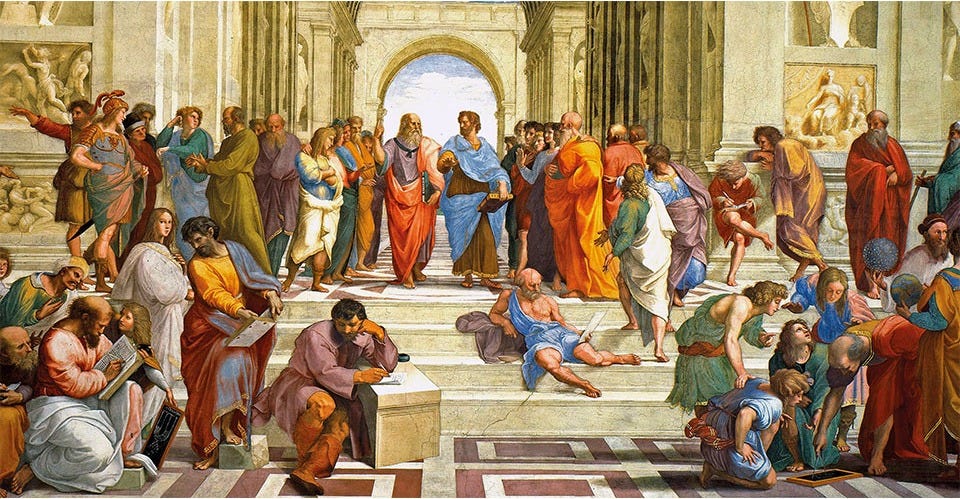
The painting above shows how dynamic and vibrant the Agora was. In the bottom right corner, we see young men learning from their older and wiser mentors. The bottom left corner contains scribes transcribing information. We see in the center a man in blue pondering whatever is written on his sheet of paper. In the background, to the right, a man in a yellow cloak is trying to understand what another in red is writing. Opposite to them, on the right side, we see a group of men discussing ideas. Finally, in the center of the background, we see two men walking together debating while a crowd listens to their exchange.
Ancient Greeks were involved in their democracy making sure that their government cared about its people. A modern day example would be French farmers protesting against regulations and economic hardship17. Their methods of protesting involve road blocks and dumping manure (cow shit) in front of government buildings. Whether or not you agree with these methods, they did not go unnoticed and all of France’s citizens became aware of the problem. This resulted in the French prime minister meeting with the farmer unions to find a solution.
Compare this to US politics where bills are passed that benefit the rich and ruling class while hindering the majority of Americans. Here is an example of Congresswoman Teresa Leger Fernández calling out a bill that aims to create a tax break for tanning beds18. This representative did a great job calling this out publicly. The fact that the ones defending this legislation did not want to read it out loud themselves shows they are well aware of how preposterous this is in regards to the American public. And yet, bills like these get passed all the time in America. One of the main reasons bills who are detrimental to most Americans pass is lack of engagement and pushback from American citizens.
Citizens Need Accountability
While it is up to a democracy’s citizens to hold their leaders accountable, I believe citizens themselves also need to be held accountable. They have an essential role to play in democracy. Ancient Greeks understood this and mandated politics to all its citizens by law; failure to fulfill your civic duty resulted in fines or public markings19.
For example, voting is considered not only a right but a civic responsibility. Yet, in the most recent US presidential election, only 65% of the 154 million eligible voters actually voted20. A third of eligible American voters did not vote. Perhaps these voters did not bother to vote because neither candidate or party represented them. In this case, an undecided voting option also known as a ‘protest vote’ should be allowed. A truly functioning democracy should pass a bill or elect a candidate if the total majority voted in favor, not based on the majority of voter turnout. If we use this logic and a bit of math and apply it to recent presidential election popular vote:
65% of eligible voters = 154 million
total eligible voters = 154 x 100/65 = 237 million
237 - 77 (Trump votes) - 75 (Kamala votes) = approximately 85 million undecided votes
Trump received 77 million votes, Harris got 75 million votes21, and undecided earned 85 million votes. Technically speaking, the most popular candidate based on total eligible votes was undecided. The American president was elected without the support of the majority of Americans. A functioning democracy with compulsive voting would have both parties select new candidates to better represent their voters and earn a total majority. I understand that American democracy does not have compulsive voting but this is clearly an argument in favor of enforcing it. Additionally, it would be a shame not to exercise a right your ancestors staked their lives and fought an entire revolution for.
I want to approach voting and civic duty from a moral point of view. Morally speaking, do western populations deserve to be worse off after turning a blind eye to their government disenfranchising them for so long? If they cannot even be bothered to vote, are they allowed to expect much from their government? Let’s take Trump winning the American election as an example. If you did not think he was the best candidate and did not vote for the opposing candidate or did not vote at all, should you be allowed to criticize his politics? This is equivalent to being a passive bystander when you see a crime being committed. The crime in this case is allowing a subpar candidate to lead your nation. We can go much further and ask: does the American public deserve corrupt politicians who participate in insider trading and respond to the needs of lobbyists over theirs if they do not bother to hold their politicians accountable?
I will leave you with this quote that highlights the importance of accountability for citizens:
“One of the penalties of refusing to participate in politics is that you end up being governed by lesser men” -Plato
I believe no one wishes to be governed by the incompetent, the corrupt, or by those who do not have their country’s best interests at heart and yet we repeatedly find ourselves in this situation. Let’s explore the challenges faced by American democracy to understand how we keep arriving at this undesired outcome.
Challenges to a Thriving Democracy
One of the main challenges to a democracy that has been highlighted due to recent news is foreign interference. This excerpt from the NYC Mayoral race where candidates are asked where they would visit first after they win illustrates the point perfectly22. All candidates answer Israel except for one that states that his focus will be on New Yorkers. That candidate is then immediately attacked by all the others… There is much to unpack here. Why should a mayor go on a diplomatic mission to another foreign country? Their responsibilities extend only to their city and its inhabitants who elected them. This problem extends through the entire American political system. During the 2024 election cycle, 58 out of 100 American senators received donations from AIPAC(American Israel Public Affairs Committee)23. It is then not surprising that these politicians would act in favor of their foreign donor at the expense of their own citizens as seen by the Antisemitism Awareness Act24. This act has been criticized for infringing on Americans right to boycott Israel and free speech. You can make an argument to defend lobbying when done by industries or big companies because they provide services, goods, and jobs. It makes sense to listen to their concerns or inputs regarding taxation or regulations. But how one can argue that lobbying done by a foreign country is not an impediment to American sovereignty and independence is beyond me.
A challenge faced by voters in our modern age is news fatigue. This is most evidently seen with Trump changing his mind about tariffs as frequently as he changes underwear. It is hard to keep up with this barrage of constant news; some of which are speculative and will not materialize. Even worse than uncertain news is fake news. Lying or omitting the truth has become so common in mainstream media and politics that voters don’t know who to trust. We already saw an example of this with Harris running different versions of the same ad in different states during her presidential campaign.
If voters are unable to access clear and accurate information, they will never be able to make an informed choice when voting. We will regress back to tribalism. We will make decisions purely on social ties and affinity or we will flock to whichever leader appears strongest. This has already begun and is the reason why American politics has become so polarized recently. People pick a faction and will not even consider the viewpoints outside of their group’s dogma. This hostile environment that stifles any hope of mature and respectful debates around complex topics repulses most people.
This is the classic adage of “Divide and Conquer”. While American citizens are too busy partaking in the tribal dual party system, fighting the culture wars, or falling for identity politics; their politicians are making millions through stock trading and cozying up to lobbyists. All the while, the most important issues that affect everyone are not addressed: living standards, housing, climate…
All of these issues are ignored because the media is not fulfilling its essential role in a democracy.
“Freedom of the press is not just important, it is imperative for a functioning democracy.”
– John F. Kennedy.
In a democracy, media is responsible for informing the public, facilitating debate, and most importantly holding those in power accountable. By always pursuing truth and informing the public, media prevents lies and deception from manipulating the public. Unfortunately, American media recently has not been doing their job. They constantly spread misinformation or never push back to question whichever narrative a speaker is presenting. It is no surprise that American media does not fulfill its responsibilities to the people. American media outlets are privately owned businesses that need to make profits. The potential for debate is hindered by the need to make money through ad revenue. Challenging opinions that go against the mainstream are not popular and do not generate profits25. Even more disturbingly, almost all of them are owned by 6 major corporations and 15 billionaires26. This is a clear limitation on the media’s ability to report news without bias if they are owned by individuals with their own agenda. Furthermore, if all the news outlets are owned by the same group, it reduces the diversity of viewpoints, impeding debate and the quest for truth. Then we end up with many seemingly different media outlets that provide the illusion of a free society with differing opinions — while hiding the manufactured dystopia we live in. The following footnote contains a short video showcasing how news outlets all receive the same instructions verbatim27.
Instead of showing one of the many examples of media controlling the narrative it shows its viewers, I prefer to show an example of good journalism and media fulfilling its responsibility to its citizens. Here is an interview of Trump by Terry Moran. Terry Moran challenges Trump’s lies up to the point where Trump threatens him and openly admits that he just wants Terry to go along with his lies:

Similarly to the news fatigue issue, and exacerbated by modern technology is the role of entertainment. America faces no shortage of entertainment with the infinite feed of social media apps, constant influx of new content on the streaming platforms, and innumerable games of all the sports leagues. This is the Roman concept of “Bread and Circuses”: distract the population from the real underlying issues through entertainment. But this concept can be applied even further than distraction, it can be extended to propaganda. I remember watching the Super Bowl LIX this year and could not help but notice the subliminal messaging. The elite at the top of the stadium saluting the crowd when they appear on the big screen, the over the top parade of the military forces who have absolutely no relation to football, military jets flying over the arena, a popular artist putting on an extravagant performance… All of this is subtle propaganda. They are telling Americans to look away from the blatant problems that need to be addressed, and instead to look at this show we put on for you. They are telling Americans that because we can put on this extravagant façade, we must be a wonderful country and you should be happy to be a part of it. It is easier to shut out all the complexities of politics, enjoy the pretty show, and not worry about the underlying issues plaguing America. Ignorance is bliss.
Another issue for America’s democracy is the logistics around voting. Before being able to vote, a citizen needs to register. In the recent presidential election, only 73.6% of citizens were registered and allowed to vote28. More than a quarter of potential voters were not able to vote in this election. I’m not sure why a citizen would need to register in the first place to be able to vote, the federal government or state government probably has a database of its citizens. But if they do need to register, why isn’t this done automatically? The Brennan Center for Justice is an organization trying to implement automatic voter registration across all states, they have implemented automatic voter registration in 23 states29.
Additionally, voting in America differs across all states or counties, even for nation-wide federal elections30. This introduces unnecessary complexity as each citizen needs to read up on their state’s or county’s voting procedures instead of following a nation-wide standard. There is also the argument to be made that federal elections are the responsibility of the federal government and not the responsibility of individual states. The federal government could provide a standardized procedure which could simplify the logistics of voting.
Another point around voting is the logistical challenge of going to a polling place to vote. A simple solution would be online voting. Many people, including myself, ask the question: if I can bank and shop online, why can’t I vote online? David Jefferson explains that the security, privacy, transparency requirements, and risks for online voting are much more complex and stringent than they are for e-commerce transactions31. An easier solution would be to make Election Day in America a holiday so that people have time to go out and vote. This is common practice in South Korea32.
Lastly, corrupt, as discussed in previous sections, or incompetent politicians are a major impediment to democracy. A potential solution would be to just get rid of the political elite by switching from a representative democracy to a direct democracy. All laws and policies would be voted on by citizens instead of senators or congress members. The major obstacle to direct democracy is the education and knowledge of Americans. Unfortunately, for a myriad of reasons, modern day America is not ancient Athens where citizens were well informed by discussing and debating at the agora. This begs the question: should politics be reserved to a select few?
Should Politics be Reserved to a Select Few?
Perhaps we do not need the whole population to become well informed citizens capable of voting on every possible issue ranging from tax laws to industry regulations to civil legislation… Not all ancient Greek philosophers supported democracy, Socrates believed that voting should not be a privilege extended to all. He compared democracy to a ship — the uneducated voting is a like a ship taken over by a crew with no knowledge of sailing. The result would be a societal shipwreck33.
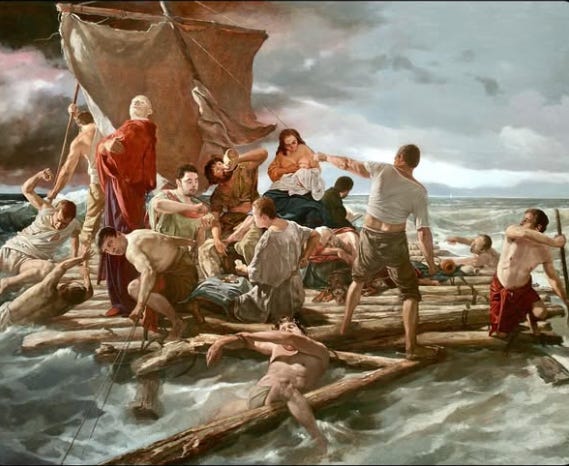
A convenient solution would be to have a handful of trustworthy citizens with society’s interests at heart that would oversee the politics. This type of government is known as aristocracy: a small, privileged ruling class holds power. Plato believed aristocracy to be the ideal form of government. He saw aristocracy as ‘the rule of the best’, where leaders needed to be wise and educated in how to best run a state34.
Sadly, we have strayed very far from Plato’s ideal for politicians. There are many examples of government officials seeming incompetent. The latest is America’s Secretary of Education reading cue cards to answer questions about the role of the Department of Education (the department she leads) during a hearing35. You can see a longer excerpt from Congresswoman Hayes’ YouTube channel where she challenges the Secretary of Education’s nonsense36.
Another recent example is the Homeland Security Secretary not understanding the concept of habeas corpus37 and thinking it allows her department to deport anyone. She believed it was a constitutional right enabling the president to deport people. She was quickly corrected, habeas corpus obligates the government to provide a public reason for imprisoning or detaining people. This separates free societies from authoritarian regimes. After being corrected, she doubles down and says the president can suspend it on his own. She had to be corrected once again for her ignorance38. As we can see, America is found wanting when it comes to the competency of its leading government officials.
If by a miracle the political elite was made up of our most competent, how do we ensure that none of them become corrupt and that they still prioritize the people’s interests? Can this be solved by one independent good actor willing to fight for what is good instead of going along with the rest of the politicians’ colluding? Is one dove in a murder of crows able to make a difference?

Bernie Sanders is known as the president America needed. He ran in the Democratic Party Primary in 2016 and 2020. He lost in 2016 to Hillary Clinton but his campaign left a lasting impression on Americans, one that would not be forgotten when he ran again in 2020. By that point Bernie Sanders was beloved by many Americans and began the 2020 Democratic Party Primary with a bang. He won the popular vote in the first three states to vote: Iowa, New Hampshire, and Nevada. It looked like Bernie Sanders was going to become the democratic party representative. However, the democratic party could not allow its leader to be a self proclaimed socialist willing to hold corporations accountable and threaten the status quo. Branko Marcetic details in his article how the democratic party did everything in its power to ensure Bernie Sanders did not become its representative39. From many party elites and staffers originally doubting Biden but then supporting him when they realized he was their only hope to defeat Bernie, to the media campaign discrediting Sanders and presenting his left leaning policies as a liability if he were to face Trump, to Obama influencing other candidates in the race to drop out and give their support to Biden… They could not allow Sanders to become the democratic party representative because he would fundamentally change the party. As Branko Marcetic explains, Joe Biden’s victory is attributed to “party elites’ willingness to sacrifice their own voters’ lives, and even risk defeat against the Right, to maintain their power”. Democrats now openly admit Biden was chosen because he was the only person who could beat Bernie Sanders40. Bernie, in a recent appearance on the Flagrant podcast, agreed that the Democratic Party removed the democratic process of electing its representative and is a ‘threat to democracy’41.
When you see someone like Bernie who had popular support but not elitist support getting tossed aside, it really brings to light how much of a venomous pit of snakes politics can be and who is really in control. Or perhaps, an even scarier thought, is that the current democratic system is not made for good natured people who want to help the majority. It forces any candidate with good intentions to have to play dirty — to associate with and serve the actors in power. If they do that for long enough, eventually they will become one of those self serving politicians who has forgotten their duty.
Perhaps our current political system attracts the kind of people who want to serve their own selfish interests, whether that be power, ego or greed… It seems that while the democratic party was able to contain Bernie Sanders in 2020, the republican party was not able to contain Donald Trump’s “hostile takeover” in 201642. This is another danger of democracy that Socrates foretold: demagogues. A demagogue is a type of political leader who relies on prejudices, false promises, and charisma to manipulate voters. Trump ticks all these boxes. He used prejudices against immigrants to instill fear into the population enabling ICE to circumvent the law and deport anybody they choose. He made false promises to garner support without ever explaining how these would be realized such as: no income tax for Americans earning less than $150K43, making Mexico pay for a wall at the border44, a sovereign wealth fund45… I will give credit where credit is due, Trump is charismatic. It is rare to see him lose control in a debate or verbal interaction. This makes him come off as competent and confident but it is only an appearance as he usually falters when pressed on more complex topics.
Socrates predicted that direct democracy is vulnerable to demagogues because having the uneducated vote makes democracy susceptible to being coerced by a demagogue. Demagogues adore the uninformed and uneducated because they are easy to manipulate. It takes little funding and marketing to secure their support, just a few incendiary words will do the trick. This is evident with Trump. Trump was largely unpopular with the educated political elite when he first entered politics. He is still quite unpopular with educated Americans but appeals to the uneducated and less well off. To go back to Socrates’ comparison of democracy to a ship, who would you want to be captain of the ship? The most competent sailor with knowledge of navigation or the person who has none of the necessary skills but was able to convince everyone else that they are the best candidate.
We have seen that direct democracies are susceptible to being coerced by demagogues and that representative democracies are vulnerable to corrupt representatives. Could there be a better way to govern? Plato proposes aristocracy, where political leaders were not elected but chosen. In this government type, people are divided into 3 classes:
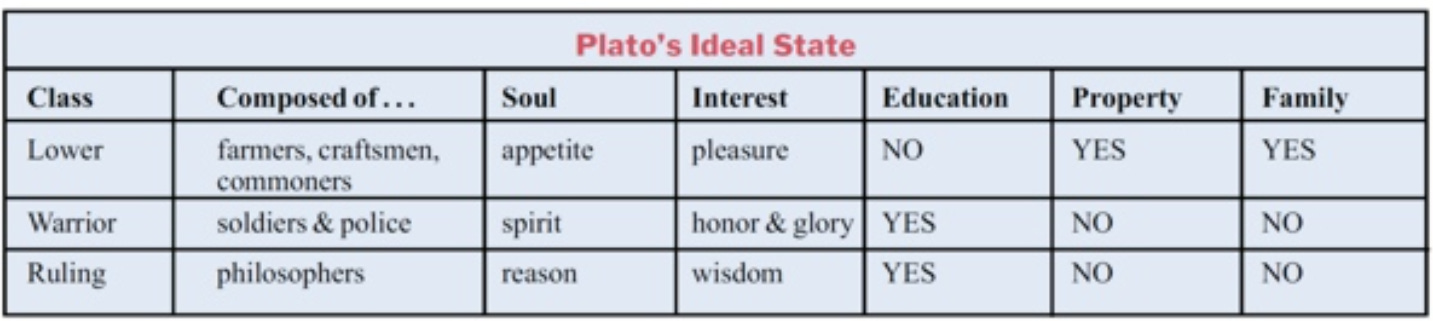
The best of the warrior class after studying philosophy would become part of the ruling class. Plato believed the warrior and ruling classes should not be allowed to own property or have their own family so that they may be wholly dedicated to their responsibilities.
There are two major flaws with Plato’s aristocracy. The first is that it is openly classist and goes against the ideals of freedom and equality. Is a member of the lower class not allowed to pursue education? Members of the warrior or ruling classes are not allowed to own property or have their own families? The second is that it is clearly outdated and does not reflect our world today. Having military leaders learn philosophy might have worked during Antiquity when societies at the time were simpler but today’s societies are much more complex due to technology, globalization, geopolitics… It is impossible to become an expert in every topic.
The ideal of aristocracy, ‘the rule of the best’, sounds great on paper. Having knowledgeable and experienced leaders in the field they govern makes sense. What if the secretary of health had a career as a doctor previously? What if the secretary of education had been a teacher and understood the education system? What if to govern a specific field, you had to demonstrate your proficiency and competency in said field? But who would be able to judge a person’s competence in a specific field? This could easily devolve into small groups deciding who they allow in and who they share power with, similarly to a class system.
Aristotle agreed with Plato’s rule of the best but rejected his vision of aristocracy. He believed that education was necessary to all citizens regardless of class and that dividing up a society by class would inevitably lead to class conflicts. Aristotle’s ideal form of government is known as ‘polity’, a state in which rich and poor respect each other’s rights and the best qualified citizens elected by all rule46. Polity is essentially a democracy where representatives cannot be coerced by the rich and the poor are educated and resistant to manipulation. Unfortunately, this is not our reality.
It is clear that blindly trusting a small group of people to act honorably and place the interests of the whole of society over their own has not been working. For the system to function properly, the leaders must be competent and trustworthy. The worst aspects of human nature that politicians are susceptible to — greed, lust for power, and pride need to be kept in check. However, it is also clear that a direct democracy, such as the popular vote for presidential elections, is susceptible to demagogues — as shown by Trump’s success. A democracy is only as good as its voter base. Educated and well informed citizens can hold their politicians accountable when they falter. In this next section, I want to explore how culture shapes a society’s politics and democracy, and how it effects citizens and politicians.
Does Culture Have a Role to Play?
Culture is regarded as the values, beliefs, language, rituals, traditions, and other behaviors passed down within any social group47. The values and beliefs of a society will influence what ideals should be pursued and what a good leader looks like. For example, in warrior cultures, the leader is usually the strongest and most fearsome fighter because that is a culture that values strength. In intellectual cultures, such as academia, intelligence is favored therefore those that rise to the top tend to be smart.
Culture helps shape the standard of leadership that politicians must aspire to to meet citizens’ expectations. But culture is ever changing and can be influenced by both citizens and politicians. Citizens will decide what values they deem desirable and the ideals to aspire to. Politicians will strive towards that ideal so that they may win their fellow citizens’ admiration and votes. Once a politician obtains power, they get to redefine what leadership looks like through their conduct. They set a new standard that subsequent politicians can compare themselves to. Citizens can also evaluate politicians through comparison with previous rulers.
At the peak of its power, the Roman civilization admired wisdom, strength, and most importantly honor. Notable figures of the time such as Marcus Aurelius embodied the ideals at the time and set the standard that others should strive for. He believed that to govern others, one must lead by example by first governing himself. His display of wisdom and self-discipline inspired others around him and produced many diligent citizens48. However this did not last indefinitely and Rome saw many corrupt emperors infamous for their violence and excesses afterwards: Commodus, Caracalla, Elagabalus…
The Romans’ downfall was due to their complacency. They stopped upholding the culture of virtue that enabled them to build a strong and prosperous society. The culture degraded, rulers prioritized the pursuit of baseless pleasures, until the Roman empire was no longer the formidable force it once was. They gave in to their primitive desires and debauchery followed: corruption, political power struggles and coups, bread and games, orgies… All of this weakened Rome from the inside until they could no longer ward off external threats. Rome eventually fell to barbarian tribes and was sacked.
American culture today is degrading similarly to what Roman culture experienced. Politicians lying and prioritizing their donors’ interests has become common practice. Music is always a great reflection of the popular attitudes of the time. The most popular American rappers sing about money, sex, violence… America’s shortcomings have become too flagrant for even Uncle Sam to hide them. America, known for its patriotism, is posting records lows recently, especially with the younger generations49.
This is to be expected when the system is failing the younger generation. Rising education costs, rising housing costs, rising asset prices and very little increases in wages. It is undoubtedly harder to afford a good life and achieve the ‘American Dream’ than it was decades ago. Conditions have gotten so bad that some people cannot afford to have kids and start their own families. A culture that does enable the social group that preserves it to pass on their traditions and values to their successors is an objectively failing culture; it will cease to exist.
Besides the economic challenges faced by younger Americans, a more pressing issue to American democracy is the youth’s inability to engage with opposing viewpoints. Greg Lukianoff and Jonathan Haidt discuss in their book, ‘The Coddling of the American Mind’, how overprotective parenting, a culture of safetyism on college campuses, and how social media have made young Americans less resilient. This has worrying implications for the future of American democracy. Michael Bloomberg states in his review of the book: “Rising intolerance for opposing viewpoints is a challenge not only on college campuses but also in our national political discourse. The future of our democracy requires us to understand what’s happening and why”.
As we saw with the role of the Agora in Athenian Democracy, a healthy democracy requires a continuous open exchange of ideas between its citizens. Something that seems to be lacking today. Is the Agora of our time social media? Social media incentivizes politicians to say provocative statements to satisfy the short-form algorithm instead of having nuanced debates. It has also led to the breakdown of dialogue between people of differing opinions. Now everyone is in their little echo chamber, only seeing what they have tailored their algorithm to show them. This makes people less accepting of differing viewpoints and makes them weaker citizens in a democratic sense. Citizens unable to debate and exchange ideas among each other become easy prey for manipulators and demagogues.
Another adverse effect of social media is the glorification of being an entrepreneur or entertainer while a standard 9 to 5 job is looked down upon. The most essential industries in our society are usually done by 9 to 5 jobs: grocery stores, education, hospitals, sanitation, energy, construction, transportation… If all the influencers and digital entertainers disappeared tomorrow, our society would be just fine. But if all of the people working in the aforementioned industries disappeared, our society would fall apart. And yet, American society nowadays idolizes fame and money over being of service to your fellow citizens. Everyone is just trying to get rich and famous.
This glorified hustle culture of competition rooted in American individualism forces citizens in a state of competition instead of cooperation. They are too busy competing with each other which prevents them from creating a system that helps everyone. America’s underdeveloped transportation networks and most expensive healthcare and education costs per capita worldwide are consequences of this mentality. When you think about American culture’s obsession with fame and money, it is very fitting that Donald Trump, an eccentric businessman that used to do reality TV, would become president. He is the perfect embodiment of the American ideal of success.
To contrast, France seems to have a healthier democracy. Corruption among politicians is not as widespread as in America, or at least not as apparent. French citizens are quite involved in politics and frequently exercise their right to protest. Cultural factors enable French citizens to participate in their democracy. France has some of the best workers rights in the world — most workers only work 35 hours a week. Almost all of education is free and healthcare is available to all its citizens. France also has family-friendly policies such as tax benefits, childcare support, generous parental leave… All of these socialist policies support French citizens and reduce their stress. People have more time and energy because they are not constantly worried about making money to feed their families or cover healthcare costs. With that extra time and energy, they can follow the news, be informed, and participate in the active political discourse. While you could argue that these are political factors, they originate from French culture’s ‘work to live’ attitude instead of ‘live to work’. French culture has materialized this attitude into policies that benefit French citizens.
Culture undoubtedly has a role to play in a democracy. As American cultural values like integrity degrade so does its democracy. American politicians no longer need to live up to a standard and citizens can no longer expect their politicians to. Can the deterioration of American democracy be prevented? Alexander Tytler argues that all democracies follow a predictable pattern and all meet the same end.
The Cycle of Democracies
Tytler was a Scottish historian and professor of Greek and Roman Antiquities during the 18th century. He argued that democracies naturally developed from initial virtue but succumbed to corruption and moral decline. Even Athenian democracy, regarded as the ideal form of democracy, was criticized by Tytler. He noted that Athens practiced slavery. Also, Athenian citizenship, and therefore right to vote, was not extended to women. His criticism of Athenian democracy is the following: “Nor were the superior classes in the actual enjoyment of a rational liberty and independence. They were perpetually divided into factions, which servilely ranked themselves under the banners of the contending demagogues; and these maintained their influence over their partisans by the most shameful corruption and bribery, of which the means were supplied alone by the plunder of the public money”50. This mirrors the current day American democracy. The political factions of today are the republicans and democrats. Politicians rally behind the banner of their faction’s representative whether that be Hillary Clinton, Joe Biden, or Donald Trump — all while indulging in corruption and bribery through lobbying and stock trading.
Tytler also criticized representative democracies: “But those governors once selected, where is the boasted freedom of the people? They must submit to their rule and control, with the same abandonment of their natural liberty, the freedom of their will, and the command of their actions, as if they were under the rule of a monarch”. Tytler’s prediction of elected government officials acting like monarchs was proved correct as America recently had ‘No Kings’ protest against the Trump administration51.
Tytler, having studied the Greek and Roman democracies, believed democracies were only temporary and doomed to fail. He states: “democracy collapses because of the loose fiscal policy ensuing, always to be followed by a dictatorship, then a monarchy”. It seems America is headed in that direction. The last year the US government had a budget surplus was in 2001. The past 24 years of budget deficits have led to a $36 trillion debt.
He introduced this cycle to explain the stages of democracy and its eventual collapse:
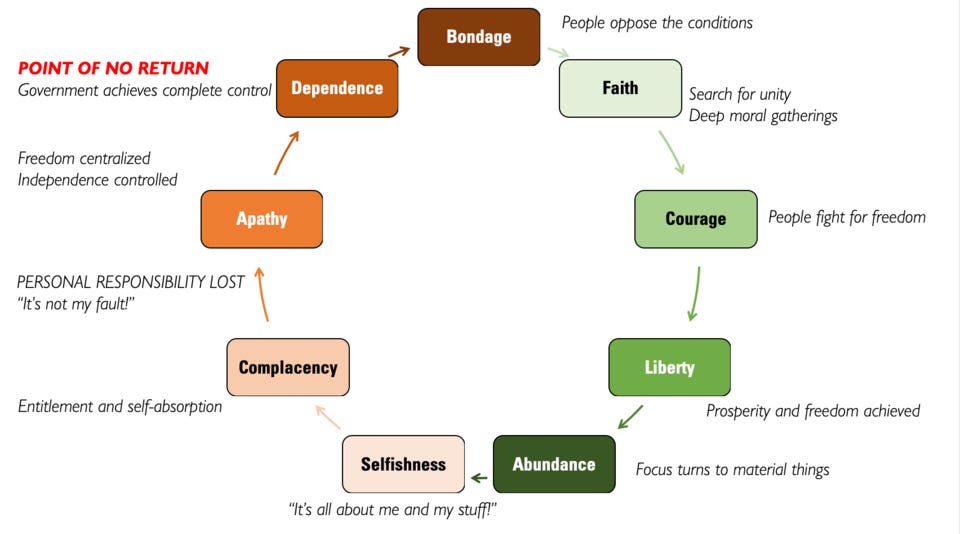
America’s history coincides with this cycle. American settlers of the new world were first under the bondage of the British monarchy. Ideas of freedom and independence unified the original 13 colonies and eventually emboldened Americans to fight for their liberty. America continued on an upwards trajectory until it became the uncontested hegemon of the world after the fall of the USSR. Americans enjoyed a period of abundance with a strong economy and cultural dominance. However, American democracy is now slipping into the downwards trajectory of this cycle.
Tytler notes: “It is a law of nature to which no experience has ever furnished an exception, that the rising grandeur and opulence of a nation must be balanced by the decline of its heroic virtues”. On this graph today, American democracy finds itself at the apathy stage. Selfish politicians have been acting in their own interests. Their constituents have been too complacent to hold them accountable. Resulting in the spread of a general feeling of apathy where Americans are politically checked out and do not show compassion for their fellow citizens.
Conclusion
Greed, lust for power, and ego are all part of human nature. Some people see others as a means to an end to satisfy these vapid desires. But the Tytler cycle of democracy is not prophecy.
It is the duty of every citizen to restrain their own desires if they negatively impact their fellow citizens. They must also contain those who have succumbed to theirs and are now malicious actors usurping democracy. A diligent citizen recognizes that democracy not only awards rights but demands duties. It is the personal responsibility of every citizen to uphold democracy. This Japanese proverb elegantly illustrates this concept:
The downfall of society begins with the individual
- Japanese Proverb
It is a shame that after all this research on my end and reading on your end, the only practical advice I can give is to be a good person who actively cares.
I would like to end on a hopeful note and remind you of all the political achievements that were obtained through activism by people who cared: 35h work week for French workers, women’s rights, gay rights, end of segregation Jim Crow laws in America, end of Apartheid South Africa, end of British colonialism in India… The list goes on.
If you made it all the way to the end, here is an excellent YouTube video that recaps the essential point you need to remember:
Personal Motivation
I wrote this because I am an idealistic young man that could not help but notice how broken the western democratic systems are and the ramifications this will have on populations worldwide. This article ended up being much longer than I had originally anticipated but I learned many things and I hope that you did too. I hope it inspires you to start caring about politics as it affects us all.
Federal Reserve Bank of St. Louis, The State of US Household Wealth: https://www.stlouisfed.org/community-development/publications/the-state-of-us-household-wealth
Washington Post article: https://www.washingtonpost.com/politics/2025/01/31/elon-musk-trump-donor-2024-election/
Blakeley, Grace. Vulture Capitalism (p. 123). Bloomsbury Publishing, 2024.
Max Lugavere, Fox News interview: https://www.youtube.com/watch?v=8IidOx0Vniw
World Economic Magazine: How Much Would a Made-in-America iPhone Cost? Bank of America Breaks It Down
Quiver Quantitative: Nancy Pelosi Trading Activity
International Business Times: Nancy Pelosi's Portfolio Beats Top Hedge Funds With 54% Gains in 2024
US Congress Legilsation: S.58 - Preventing Elected Leaders from Owning Securities and Investments (PELOSI) Act
History: Ancient Greek Democracy
National Geographic: Democracy (Ancient Greece)
United States Census Bureau: 2024 Presidential Election Voting and Registration Tables Now Available
CNN Politics: Election 2024: Presidential results
Instagram Reel: NYC Mayoral Race Excerpt
OpenSecrets: Money from Pro-Israel to US Senators, 2023-2024
Path Finder: The Big Six’s big media game
TitleMax: Who Owns Your News
United States Census Bureau: 2024 Presidential Election Voting and Registration Tables Now Available
Brennan Center for Justice: Automatic Voter Registration
MSNBC Opinion piece: Voting in the U.S. shouldn't be this hard
Verified Voting: If I Can Shop and Bank Online, Why Can’t I Vote Online?
The Collector: How Did Socrates View Democracy?
Teach Democracy: BRIA 26 1 Plato and Aristotle on Tyranny and the Rule of Law
Facebook video: Hayes and Secretary of Education hearing
PolitiFact: Build a wall, and make Mexico pay for it
Britannica: Political theory of Aristotle
American Psychological Association: APA Dictionary of Psychology
Chandler Institute of Governance: Ancient Wisdom for Modern Leaders
Wikipedia: Alexander Fraser Tytler
I think we should bring back aristocracy