Three Wise Monkeys
a misinterpreted symbol

Everyone is familiar with the three monkey emojis: 🙈🙉🙊. They symbolize the proverb “See no evil, Hear no evil, Speak no evil”. But many do not know where this symbol originates and its meaning.
Origins
Confucius’ Code from China has a similar proverb: “Look not at what is contrary to propriety; listen not to what is contrary to propriety; speak not what is contrary to propriety.” which is likely the original form1. In this context, propriety means accepted standards of behavior or morals. Buddhist monks brought these teachings to Japan in the 8th century where it became popular wisdom. In Japanese, the proverb was translated into “Mizaru, Kikazaru, Iwazaru” meaning “See not, Hear not, Speak not”. The suffix -zaru represents negation in the Japanese language but is also the modified word for saru which means monkey2. Each monkey is named after the action they forbid. Mizaru is the monkey who sees no evil by covering its eyes. Kikazaru hears no evil by covering its ears. Iwazaru speaks no evil by covering its mouth. The first physical depiction of the trio still standing today is a carving at the Tōshō-gū shrine in Nikkō Japan.
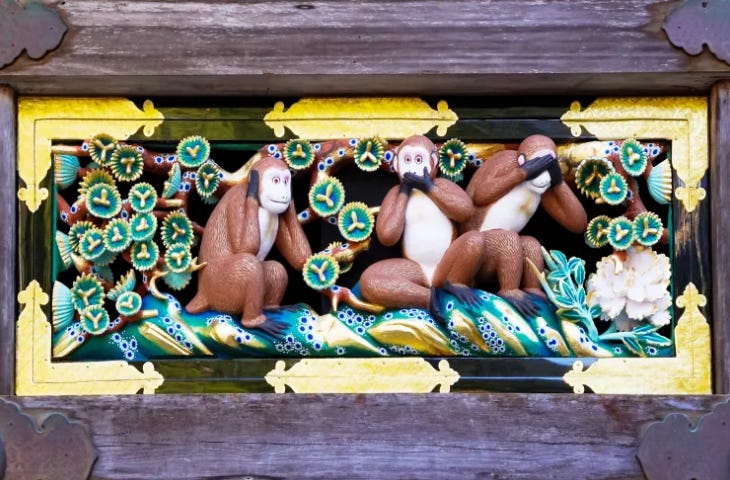
The original meaning of this proverb is to act ethically and morally by avoiding evil in every form. The monkeys are symbols of purity and virtue. They prohibit engaging in negative or destructive behaviors. Mizaru embodies prudence by refusing to witness evil. Ignorance shields us from the darkness of evil. By never seeing any evil, we will never learn how to replicate it. Kikazaru covers his hears to prevent any evil words from entering the brain. He reminds us that what we expose our minds too influences our thoughts. Lastly, Iwazaru covers his mouth, symbolizing restraint and advises against spreading negativity into the world.
The symbol of the three wise monkeys is also present in India. Gandhi was gifted a figurine of the three wise monkeys by a Japanese monk named Nishidatsu Fuji3. Gandhi’s philosophy of non-violence and avoiding negativity aligns with the three wise monkeys’ wisdom.
Spread and Misinterpretation
The three monkeys first made their appearance in western countries in Britain in the 1900s4. Small statuettes of the monkeys were carried as good luck charms by British soldiers during the first world war.
The original meaning of the three wise monkeys can be summed up by: “not engaging in evil”. Yet in western cultures, the symbolism of the monkeys is not received in the same way. Some view the monkeys as passive bystanders that ignore wrongdoing. ‘See no evil’ becomes ‘turn a blind eye to wrongdoings’, ‘hear no evil’ transforms into ‘ignore those asking for help’, and ‘say no evil’ morphs into ‘do not speak up’. Western cultures see the three wise monkeys as the inactions against evil that allow it to exist. But how could a symbol that stands against the spread of evil be interpreted as allowing evil to proliferate?
Differing Perspectives
The differing meanings extracted from the three wise monkeys offer a glimpse into the differences in how eastern and western cultures operate. One of these major cultural differences is the balance between collectivism and individualism.
Eastern cultures tend to value collectivism over individualism. They prioritize the wellbeing of the group over the wellbeing of each individual. Cooperation is primordial while selfishness is frowned upon. Individuals must conform to rules and expectations to maintain the group status quo.
On the other hand, western cultures take a more individualistic approach. Individualist cultures see the ‘I’ as king. The ‘I’ is always the hero of the story. Competition is encouraged and its victors celebrated. Individualism pedestalizes those who take action on their own initiative, those who believe in themselves, those who make themselves known.
After examining the cultural differences, their interpretations of the three monkeys make more sense. As collectivist cultures prioritize order and harmony, they incentivize their members to practice restraint and preserve the peace. This explains why the original three wise monkeys all provide dogma to individuals on how to act. The eastern cultures believe they can root out evil by adhering to strict rules and acting morally. If no one speaks evil, hears evil, or sees evil — society will harmonize and flourish. Contrary to western cultures who accept that evil exists in the world externally, usually in the form of the other. Western cultures lean more towards competition than cooperation. They believe one must compete against evil and defeat it. Those who triumph over evil are celebrated as heroes.
Eastern cultures believe evil originates internally from humans and that every single human being must fight the evil within them for the overall good of their community. Western cultures believe evil is an external force that takes on many forms: nature, rival humans… Western culture dictates that individuals must fight these external threats. Those who refuse to act are shamed as cowards for their inaction.
"The only thing necessary for the triumph of evil is for good men to do nothing" - Commonly attributed to Edmund Burke
An Addition to the Trio
While the wise monkeys usually appear as a trio, a less well known fourth monkey also exists. He is named Shizaru, meaning ‘do no evil’. He was depicted with his hands in between his legs. He is the rightmost monkey in the picture below:
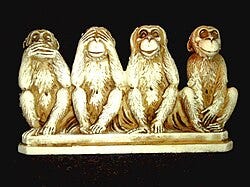
Shizaru emphasizes the importance of aligning one’s actions with one’s beliefs by avoiding actions that may harm others. Shizaru’s hands are covering his genitalia, potentially alluding to renouncing sexual temptations.
The wise monkeys contain timeless wisdom but their symbol has been revisited and modernized for our era5:
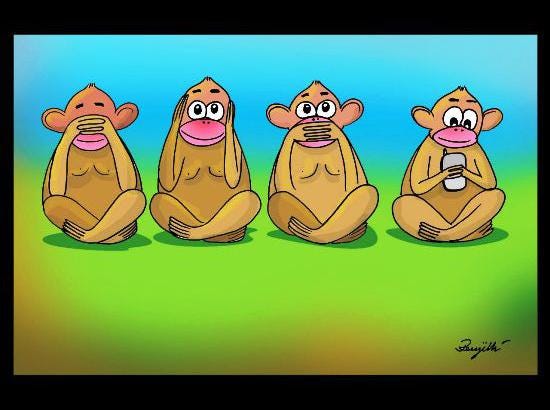
Shizaru is holding a phone instead of having his hands between his legs. Perhaps the most efficient way to do no evil is to distract all of us with technology. As we consume more and more, act less and less, the potential for evil deeds diminishes. Technological progress could eventually reach a point where humans do not need to do anything and can simply waste their lives away consuming endless content. A morally neutral dystopia.
I am not suggesting this as a solution to evil but merely entertaining the thought.
House of Good Fortune: Three Wise Monkeys
Oxford Reference: Three Wise Monkeys